

 Gabriel Fitzpatrick
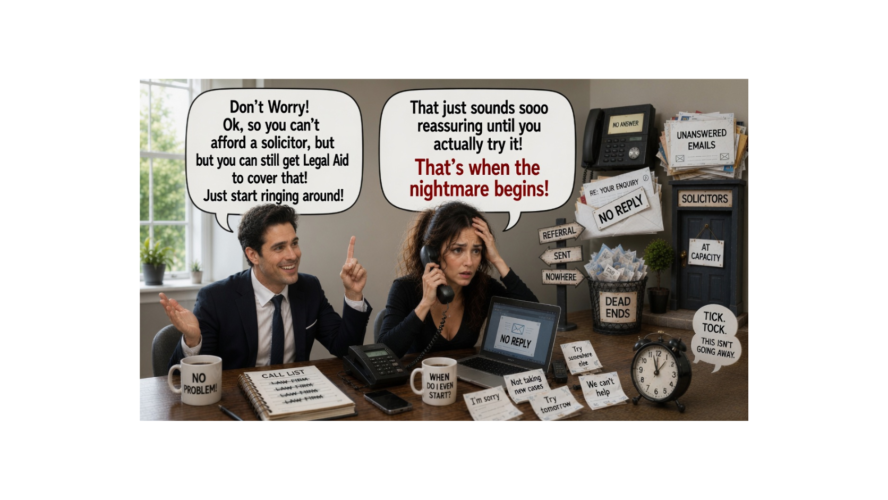
“Don’t worry about not being able to afford a solicitor. You can get legal aid for that. Just start ringing around.” It all sounds reassuring enough until you actually try it. That’s when the nightmare begins: unanswered calls, emails that go nowhere, firms with no capacity and the growing realisation that your legal problem won’t wait.
On 17 July 2026, the House of Commons Justice Committee warned that, without reform, “legal aid will continue to decline as a practical route to justice.”
Its report describes more than a funding crisis. It depicts a system where scarce providers, administrative friction, technological failure and weak information can prevent communication from beginning, continuing or producing an actionable answer.
That creates a distinct ReplyResearch question. Legal aid may exist legislatively and statistically, but does it remain practically reachable when people encounter silence, delay, repeated referrals or replies that resolve nothing?
Access Begins Before Legal Advice
A person cannot benefit from expert representation until contact has been established. Every unanswered telephone call, unacknowledged email and failed referral therefore sits upstream from the legal outcome eventually recorded.
This does not mean legal aid lawyers are casually ignoring vulnerable people. Many responsiveness failures arise because overloaded providers lack funded capacity, administrative time or reliable systems for handling demand.
Nevertheless, the claimant experiences the same immediate result. Whether silence reflects indifference, exhaustion or infrastructure failure, a deadline continues approaching while the person remains uncertain about who, if anyone, is helping.
Responsiveness should therefore be treated as part of access to justice, not merely customer service. Contactability determines whether legal rights can move from theoretical entitlement into timely, usable assistance.
The Newest Evidence Questions Practical Coverage
The Justice Committee’s 17 July 2026 report concluded that the Government’s “current measures of service coverage are invalid,” because provider contracts and office locations do not establish whether help is genuinely obtainable.
By June 2026, the Committee found twenty-one procurement areas without face-to-face housing and debt provision. Nine family areas also failed the Legal Aid Agency’s own minimum provision standard.
Those figures describe geographical scarcity, but they also predict communication pressure. Where alternatives disappear, the remaining offices receive more approaches, waiting grows, and the probability of rejection or silence rises.
The important unit is not simply the contracted office. It is the completed connection between a person needing help and a suitably qualified provider with current capacity to act.
Turning People Away Is A Responsiveness Event
The Ministry of Justice and PA Consulting’s provider survey, published 19 January 2024, reported that “80% of participants stated demand … was above a standard level.”
Among organisations reporting excess demand, providers estimated that they had turned away an average twenty-six potentially eligible cases during one month. London organisations reported a considerably higher average.
A refusal can be prompt, clear and useful. It can also arrive after repeated attempts, provide no viable alternative, or leave the applicant uncertain whether the enquiry was received.
Current national statistics do not reveal how many unsuccessful approaches were unanswered, how long refusals took, whether referrals connected successfully, or how many applicants abandoned their search altogether.
One Successful Referral In Sixteen
Evidence considered by the Justice Committee in July 2026 included Public Law Project referral data showing that only one in sixteen attempted immigration and asylum legal aid referrals succeeded.
That finding measures referral success, but it also exposes an extraordinary communications burden. Someone may need numerous approaches merely to locate one provider able to consider taking the case.
Each unsuccessful approach consumes time for the applicant and provider. For people facing removal, homelessness, family separation or loss of income, that process can damage substantive rights before representation begins.
A legal aid system should not describe repeated failed approaches as somebody else’s problem. The referral journey is part of the service, even when no individual organisation controls it.
An Office On A Map Is Not A Service
The Ministry of Justice’s quarterly legal aid statistics, published 25 June 2026, describe contracted-provider information as a “proxy measure of capacity only,” rather than evidence of actual client access.
The same publication warns that office geography “cannot be used as a reliable indicator” of where legal aid benefits are delivered or whether sufficient help exists locally.
A provider may hold a contract while limiting new work, covering only particular case types, operating remotely, facing recruitment shortages or concentrating capacity on existing clients.
Directories therefore risk presenting administrative availability as human reachability. A name, telephone number and postcode do not demonstrate that an enquiry will receive a timely, meaningful response.
Legal Aid Deserts Are Contact Deserts
The Law Society’s housing research, published 12 May 2026, argued that “Legal aid can make the difference between home and homelessness” when tenants face possession or unsafe conditions.
It found that twenty-five million people, representing forty-one percent of England and Wales, lived without a housing legal aid provider located inside their local authority area.
Absence of a local office does not prove that nobody can obtain help. Remote advice, outreach and providers beyond council boundaries may sometimes connect people successfully.
But distance transfers work onto the applicant. Finding alternatives, checking eligibility, repeating personal histories and testing whether distant providers have capacity become unpaid stages in securing legal protection.
Remote Access Can Widen And Narrow Reachability
The Public Accounts Committee’s report, published 7 January 2026, was “not satisfied that MoJ and the Legal Aid Agency are doing enough” for eligible people, particularly those digitally excluded.
The Committee estimated that approximately twenty-four percent of people were digitally excluded and highlighted continuing gaps in face-to-face housing and debt provision across England and Wales.
Remote advice can remove travel, broaden geographic reach and help specialist providers serve dispersed clients. It can also create new barriers involving devices, data, privacy, language and digital confidence.
For ReplyResearch, the decisive question is not whether contact is remote. It is whether the channel produces dependable acknowledgement, human understanding, continuity and a useful next step.
Digital Availability Is Not Digital Accessibility
Someone may possess a smartphone yet struggle to scan evidence, complete long forms, identify the correct legal category or maintain contact while living in temporary accommodation.
Automated guidance can direct straightforward enquiries efficiently. For complex cases, however, an apparently helpful response may simply redirect responsibility without establishing that another provider is available.
Digital exclusion should therefore include communication capability, not merely internet access. A service is not reachable when its route exists technically but demands skills, stability or persistence many users lack.
Legal aid clients often approach services during crisis. Systems designed around confident, organised users can turn cognitive overload into apparent disengagement, then record the resulting abandonment as nothing at all.
Silence Becomes More Dangerous Near Deadlines
Legal problems rarely pause while communication fails. Limitation periods, possession hearings, benefit decisions, immigration action and family proceedings continue moving, even when an applicant cannot secure advice.
A slow reply may therefore be legally different from a prompt one, although both eventually contain identical information. Timing can determine whether evidence is preserved or an appeal remains possible.
Unhelpful replies also create delay. Generic signposting, unexplained rejection or referral to an unavailable provider can look like completion internally while sending the applicant into another communications loop.
The proper measure is not whether something was sent. It is whether the response arrived soon enough, addressed the enquiry and enabled the person to take a realistic next step.
The Official Performance Picture Looks Reassuring
The Legal Aid Agency’s annual report, published 16 October 2025, describes its mission as delivering “fair, prompt and effective access” to publicly funded legal help.
It reported ninety-five percent of civil applications processed within twenty working days and eighty-four percent of civil customer-service calls answered within five minutes during 2024–25.
Those measures are valuable. They show whether applications already inside the Agency’s system move promptly and whether callers reaching designated lines receive timely telephone handling.
They do not reveal how long citizens spend finding a provider, how many providers never answer, whether responses are useful, or how frequently a referral ends without contact.
The Measurement Gap Is Already Documented
The National Audit Office’s 9 February 2024 report stated that “Theoretical eligibility for legal aid is not enough” and found that government “does not collect sufficient data” on practical access.
It observed that Legal Aid Agency indicators concentrate on operational processes, including application processing and call answering, rather than measuring whether eligible people actually obtain legal aid services.
That distinction is central. A system can meet its internal processing targets while applicants remain outside its measurable perimeter, repeatedly contacting providers who have no capacity to assist.
The missing information concerns the journey before formal acceptance: attempted contacts, acknowledgements, substantive replies, rejected referrals, unsuccessful handovers, repeated explanations, mounting delay and eventual abandonment.
Evidence Gaps Conceal Communication Failures
Dr Natalie Byrom’s Nuffield Foundation report, published in March 2024, concluded that “Existing provision of legal advice and representation is inadequate to meet this need.”
The report also drew attention to substantial evidence and data gaps surrounding access to justice, including uncertainty about whether remote and digital alternatives deliver equivalent quality.
Responsiveness belongs inside that gap. Without enquiry-level data, policymakers cannot distinguish low demand from unmet demand, successful self-service from exhaustion, or purposeful withdrawal from failed communication.
Silence produces almost no administrative trace. Unless attempted contact is recorded, the people who never establish representation can disappear from statistics precisely because the system failed to reach them.
The Missing Legal Aid Responsiveness Dataset
A national dataset should measure median time to acknowledgement and meaningful response, while also publishing slower-tail performance rather than allowing exceptionally delayed cases to disappear inside averages.
It should record the proportion of enquiries receiving no response after defined intervals, the average number of provider approaches, referral completion and the point at which applicants abandon contact.
Response quality also needs assessment. A useful reply should answer the immediate question, explain any refusal clearly, identify realistic alternatives and flag urgent deadlines or emergency routes.
Results should be segmented by legal category, geography, channel, disability and digital exclusion. Otherwise, acceptable national averages may conceal severe barriers among people facing the greatest consequences.
Measurement Must Not Become Provider Punishment
Publishing responsiveness data without context could unfairly stigmatise organisations absorbing impossible demand. A provider rejecting cases promptly may appear worse than one allowing enquiries to vanish unrecorded.
Metrics should therefore distinguish capacity, response behaviour and referral outcomes. They should show demand relative to funded resources, not convert structural underinvestment into simplistic customer-service league tables.
The purpose is to make unmet need visible and improve handovers. It is not to suggest that exhausted legal aid teams can solve national scarcity by writing faster emails.
Good measurement would instead identify where additional capacity, administrative support, better technology or specialist provision could produce the largest measurable improvement in practical legal access.
A Refusal Can Still Be Useful
When a provider cannot accept a case, a timely refusal prevents damaging uncertainty. The response should explain the position, preserve dignity and avoid implying that the applicant’s problem lacks merit.
Signposting becomes meaningful only when the destination is plausible. Sending everybody towards the same overstretched directory merely relocates the queue and allows the original organisation to count an interaction as resolved.
A stronger system would support closed-loop referrals, confirming whether another provider received the approach and had capacity, rather than leaving vulnerable applicants to repeat an increasingly desperate search.
Where no provider is available, that failure should be recorded centrally. Unmet demand needs to become visible evidence, not private disappointment experienced separately by thousands of applicants.
From Contactability To Continuity
Initial contact is only the first stage. Clients also need updates, explanations of delays, notification of responsibility changes and clear instructions when further information or action is required.
A provider may be reachable before accepting a case but difficult to contact afterwards. That creates uncertainty about hearings, evidence, funding decisions and whether anybody remains responsible.
Continuity metrics could measure update intervals, unanswered client messages and time taken to explain important developments. These measures would complement professional quality standards rather than replacing them.
Legal expertise and communication are not competing virtues. Advice cannot protect somebody when it arrives after the relevant deadline, remains incomprehensible or never reaches the person concerned.
Legal Aid Has A Reply Problem
The strongest ReplyResearch argument is not that unresponsiveness caused the legal aid crisis. Funding, workforce attrition, administrative burden, geographical scarcity and failing technology clearly shape provider behaviour.
The argument is that responsiveness reveals how those pressures reach people. No reply, slow reply and unhelpful reply are observable symptoms of access collapsing at the point of contact.
Measuring contracts, expenditure and completed cases remains necessary. But those figures cannot describe the person who contacted twelve providers, received three refusals, heard nothing from eight and remained waiting on one.
Legal aid shouldn’t just be about whether you qualify on paper. It’s about whether you can actually get through to someone, get an answer that makes sense, and get help before your situation completely falls apart’
Justice Starts With An Answer
The emerging evidence suggests that England and Wales possess detailed information about funded activity but remarkably little about failed approaches, communication quality and abandoned searches.
That blind spot matters because the people least able to persist are often those facing poverty, disability, insecure housing, language barriers, trauma or rapidly approaching legal deadlines.
A practical right to legal aid must include a practical route into legal aid. Until reachability and responsiveness are measured, official coverage can continue looking healthier than lived access.
Justice may ultimately depend upon expert advice, representation and adjudication. But for the person outside the system, it begins with something more elementary: somebody receiving the enquiry and replying usefully.

Sources And Relevant Reading for Need Legal Aid? It’s Your Right. But Actually Getting It? Yeah, Right
House of Commons Justice Committee, Access to Justice: Legal Aid, published 17 July 2026. The report examines capacity, administration, coverage, digital access
Ministry of Justice, Legal Aid Statistics: England and Wales, January to March 2026, published 25 June 2026. It explains provider measures, geographic limitations and cyberattack-related statistical disruption.
The Law Society, Homelessness Threat As Millions Face An Uphill Struggle For Justice, published 12 May 2026. The release presents updated housing legal aid desert figures. https://www.lawsociety.org.uk/contact-or-visit-us/press-office/press-releases/homelessness-threat-as-millions-face-an-uphill-struggle-for-justice (Law Society)
House of Commons Public Accounts Committee, Ministry of Justice Follow-Up: Autumn 2025, published 7 January 2026. The report examines digital exclusion, face-to-face provision and legal aid accessibility. https://committees.parliament.uk/publications/50887/documents/281680/default/ (UK Parliament Committees)
Further Relevant Reading
Legal Aid Agency, Annual Report And Accounts 2024–25, published 16 October 2025. The performance report provides application-processing, telephone-answering, complaints and payment measures used to assess service delivery. https://www.gov.uk/government/publications/legal-aid-agency-annual-report-and-accounts-2024-to-2025/annual-report-and-accounts-2024-25-performance-report-html (GOV.UK)
Ministry of Justice and PA Consulting, Review Of Civil Legal Aid: Provider Survey Report, published 19 January 2024. The survey examines demand, rejected cases, provider confidence, recruitment and sustainability. https://www.gov.uk/government/publications/review-of-civil-legal-aid-provider-survey-report (GOV.UK)
National Audit Office, Government’s Management Of Legal Aid, published 9 February 2024. The report examines practical access, provider capacity, government data limitations and the inadequacy of process-focused performance indicators. https://www.nao.org.uk/reports/governments-management-of-legal-aid/ (National Audit Office (NAO))
Dr Natalie Byrom, Where Has My Justice Gone?, published March 2024. The report reviews legal need, access-to-justice provision and important remaining evidence gaps. https://www.nuffieldfoundation.org/wp-content/uploads/2024/Where-has-my-justice-gone.pdf (Nuffield Foundation)

Following the required four-part structure and “Cause and Cure” mapping in your specification.
Footnote Zone for Need Legal Aid? It’s Your Right. But Actually Getting It? Yeah, Right
Disclosure: The diagnostic tools referenced below were developed by NokNok, a specialist in online responsiveness tool design.
This Footnote Zone uses NokNok’s diagnostic toolkit to examine whether legal aid providers can be found, contacted and relied upon to deliver timely, relevant and practically useful responses.
- Email Finder: People seeking legal aid may encounter incomplete directories, web forms without visible email alternatives, outdated contact details or offices whose published routes do not reveal whether enquiries are actively monitored. Email Finder scans a provider’s website and related public-facing materials for published email addresses, then identifies missing routes, inconsistencies, obsolete details and other structural contactability gaps.
- Reply Radar: The article describes unanswered calls, ignored messages, delayed replies and providers whose overstretched teams cannot reliably respond to new enquiries. Reply Radar deploys targeted test emails to legal aid providers and quantitatively measures acknowledgement rates, substantive reply rates, response latency, consistency and differences between published availability and observable responsiveness.
- Compliance Sniffer: Some applicants receive generic rejections, vague signposting or replies that fail to explain whether the firm lacks capacity, cannot handle the relevant legal category or knows of a realistic alternative. Compliance Sniffer analyzes incoming responses against objective standards for clarity, relevance, usefulness, escalation, referral quality and basic communication compliance.
- Mystery Shopper: The journey into legal aid can involve directories, eligibility checks, repeated telephone calls, obstructive forms, unsuccessful referrals and providers that appear available until an applicant attempts contact. Mystery Shopper executes an end-to-end responsiveness user-experience audit, recording how a real person finds a provider, makes an enquiry, receives a response and attempts to progress or escalate the matter.
Disclosure: The diagnostic tools referenced in this Footnote Zone were developed by NokNok, a specialist in online responsiveness tool design. ReplyResearch may use NokNok tools, resources or analysis when preparing coverage, while retaining responsibility for its editorial decisions, including what topics to cover, what sources to cite and how stories are presented. Read the full ReplyResearch Collaborative Disclosure Policy.
::