
 Jonathan Friedman
An alarming study is showing that well-meaning advice to disabled jobseekers may be silently backfiring
We’ve all heard it.
If you’re applying for a job, don’t dwell on the negatives.
Sell yourself.
Focus on your strengths.
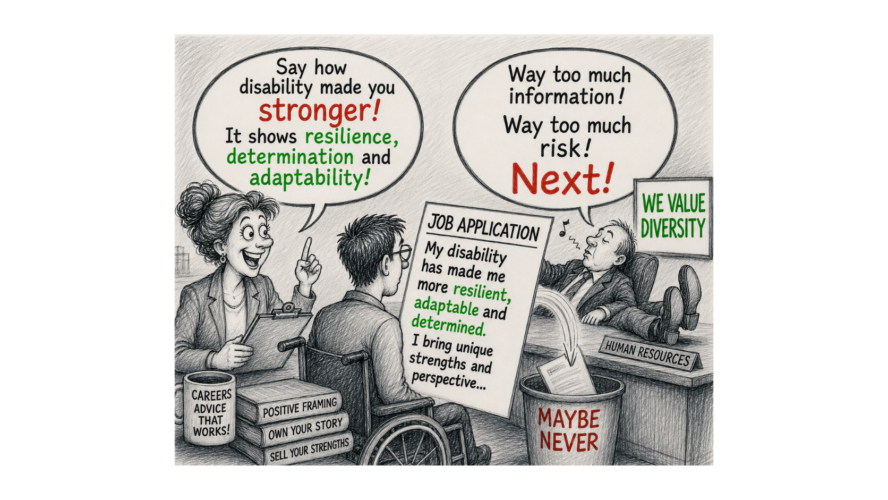
If you decide to tell an employer about your disability, explain how it’s made you more resilient. More adaptable. More determined. Show them what you’ve overcome.
It sounds like exactly the sort of advice that ought to work.
In fact, it sounds almost impossible to argue with.
Until somebody actually tested it.
The result is one of the most surprising pieces of recruitment research we’ve seen for years.
The advice everyone thought made sense
For years, disability-employment specialists, careers advisers and researchers have discussed ways applicants might present disability positively.
The thinking is simple.
If employers hold unconscious stereotypes about disability, perhaps better communication can overcome them.
Don’t simply disclose the disability.
Explain the positives.
Talk about resilience.
Talk about determination.
Talk about the unique perspective your experiences have given you.
Communicate better.
Get a better result.
That’s the theory.
The researchers discovered something nobody expected.
They stopped asking employers what they said
Researchers (working in conjunction with the Utrecht University School of Governance in the Netherlands) publishing in the Journal of Organizational Behavior in February 2026 first asked employers how they thought they would respond to disabled applicants.
The answers sounded reassuring.
Most employers claimed disability wouldn’t influence their decisions very much.
Everything looked encouraging.
Then the researchers did something far more interesting.
They stopped asking employers what they said they would do.
Instead, they watched what they actually did.
That’s when the story changed completely.
Reality told a very different story
The researchers carried out a field experiment involving 1,509 genuine job vacancies.
Real employers.
Real applications.
Real hiring decisions.
Applicants who disclosed wheelchair use were already substantially less likely to receive a callback.
That finding alone should concern anyone interested in fair recruitment.
But what happened next was astonishing.
Applicants who used carefully designed wording intended to present disability positively received 38% fewer callbacks than applicants who disclosed the disability without using that strategy.
Read that again.
The communication advice designed to reduce discrimination appeared, in this study, to make employers even less likely to reply.
The communication that backfired
The researchers were testing what academics call “claiming.”
It’s an awkward name for a very familiar idea.
Instead of simply mentioning a disability, applicants explain the strengths that have come from living with it.
“I’m resilient.”
“I’ve developed exceptional problem-solving skills.”
“I’ve learned adaptability.”
Exactly the sort of thing most of us assume employers want to hear.
Instead, the researchers believe this may have drawn greater attention to the disability itself, triggering the very stereotypes applicants were trying to overcome.
The applicants communicated better.
The replies became fewer.
This isn’t just a discrimination story
Most research into disability recruitment measures attitudes.
This research measured something much simpler.
Replies.
Callbacks.
Human contact.
The communication just… stopped.
The applicant wasn’t rude.
The CV wasn’t badly written.
The application wasn’t incomplete.
The advice had been followed.
The strengths had been highlighted.
Everything had apparently been done properly.
Yet the phone never rang.
The email never came.
The employer simply disappeared into silence.
Have we been asking the wrong people to change?
Every time disabled people struggle to get jobs, somebody has another piece of advice.
Rewrite your CV.
Improve your personal statement.
Sell yourself more effectively.
Frame your disability differently.
Tell a stronger story.
Communicate better.
But this research raises an uncomfortable possibility.
What if disabled applicants aren’t the communication problem?
What if we’ve spent years trying to optimise the message while paying too little attention to the people receiving it?
The cruel irony
Imagine being told there’s a smarter way to beat discrimination.
Imagine believing it.
Imagine carefully rewriting your application.
Choosing every word.
Making sure you sound positive.
Making sure you sound resilient.
Making sure you sound employable.
Then discovering that the advice itself may have reduced your chances of getting a reply.
That’s a particularly painful irony.
The people trying hardest to overcome prejudice through better communication may still find themselves confronting exactly the same silence.
A ReplyResearch perspective
ReplyResearch studies no reply, slow reply, unhelpful reply and organisational unreachability.
This research fits that lens almost perfectly.
Its outcome wasn’t simply discrimination.
It was the disappearance of communication.
The applicant reached out.
The employer quietly failed to reach back.
Perhaps that’s the most uncomfortable finding of all.
For years we’ve concentrated on teaching disabled applicants how to communicate more effectively.
Maybe the bigger question is whether recruitment has become too comfortable expecting applicants to solve communication failures that don’t originate with them.
Because if following the advice still leaves the inbox empty…
perhaps the biggest communication problem isn’t what the applicant wrote.
It’s what happened after someone else read it.

Sources and relevant reading for “Say how disability made you stronger” they said. Outcome? Brutal
1. Discrimination Against People With Disabilities in Hiring and Strategies to Reduce It: Evidence From Resumes – Rosanna Nagtegaal, Noortje de Boer and Lars Tummers; Journal of Organizational Behavior; 13 February 2026.
This is the study at the centre of the article. Across two survey experiments and a field experiment involving 1,509 real job applications, it found that disability disclosure reduced callbacks and that the “claiming” strategy – emphasising how disability had made the applicant stronger – produced a 38% lower chance of callback than straightforward disclosure.
2. Productivity Signals and Disability-Related Hiring Discrimination: Evidence from a Field Experiment – Armenak Antinyan, Ian Burn and Melanie K. Jones; IZA Discussion Paper No. 17290; September 2024.
A UK correspondence experiment covering about 4,000 vacancies found a 15% callback gap for applicants whose wheelchair use signalled a mobility impairment. Extra qualifications, technical skills and a positive reference did not close the gap and sometimes widened it, reinforcing the article’s challenge to the idea that applicants can simply optimise their way around discrimination.
3. The State of Hiring Discrimination: A Meta-Analysis of (Almost) All Recent Correspondence Experiments – Louis Lippens, Siel Vermeiren and Stijn Baert; European Economic Review, volume 151; January 2023.
This large meta-analysis brings together correspondence experiments in which otherwise comparable applications receive different employer responses. It estimates that candidates with disabilities are about 41% less likely to receive a positive response, placing the article’s striking experiment within a much wider pattern of callback discrimination.
4. Why Do Employers (Fail to) Hire People with Disabilities? A Systematic Review of Capabilities, Opportunities and Motivations – Rosanna Nagtegaal, Noortje de Boer, Rik van Berkel, Belle Derks and Lars Tummers; Journal of Occupational Rehabilitation; 23 January 2023.
Reviewing 47 studies, the authors found that most identified factors were employer-side barriers. The most frequently reported were expectations that disabled people would be less productive, assumptions that they would cost more, and a lack of disability knowledge – directly supporting the article’s question about whether the receiver, rather than the applicant’s wording, is the real problem.
5. Disability Disclosure as an Impression Management Technique Used in the Workplace: A Grounded Theory Investigation – Christine M. Manno, Rachel Glade, Lynn C. Koch, Lauren S. Simon, Phillip D. Rumrill and Christopher C. Rosen; Work; 9 April 2024.
This qualitative study examines how disabled people use disclosure, claiming, downplaying and other impression-management strategies in trying to be seen as the “ideal employee”. It shows how complicated and effortful that self-presentation can become, and why the burden of managing other people’s assumptions can itself be damaging.
6. Disabled People’s Lived Experience of Employment in the UK – Disability Unit and Office for Equality and Opportunity; 17 July 2025.
This UK government review finds barriers across every aspect of employment and concludes that negative perceptions of impairment affect hiring and retention. Its emphasis on systemic discrimination supports the article’s argument that disabled applicants are too often asked to repair communication and recruitment failures that do not originate with them.
7. Employment Support for Disabled People: Disability at Work – House of Commons Work and Pensions Committee, Seventh Report of Session 2024-26; 21 May 2026.
This recent parliamentary report describes the recruitment process as the first, and often one of the most inaccessible, workplace practices encountered by disabled people. It places the article’s callback problem within a broader pattern of employer reluctance, inaccessible systems and failures to respond properly to disabled people’s needs.
Footnote Zone for “Say How Disability Made You Stronger,” They Said. Outcome? Brutal
Disclosure: The diagnostic tools referenced below were developed by NokNok, a specialist in online responsiveness tool design.
This Footnote Zone uses NokNok’s diagnostic toolkit to examine how disability-related recruitment silence, reduced callback rates, potentially counterproductive application advice, and opaque hiring journeys can be identified and measured.
• Email Finder: Disabled applicants may be encouraged to disclose sensitive information while employers provide no clear route for questions, reasonable-adjustment requests, or follow-up when an application disappears into silence. Email Finder scans an organisation’s website and related public-facing materials for published email addresses, then reports missing routes, discrepancies, structural deficiencies, and other contactability gaps.
• Reply Radar: The article’s central outcome is a measurable loss of replies: applicants disclosing wheelchair use receive fewer callbacks, while those using positive “claiming” language receive 38% fewer callbacks than those who disclose without that strategy. Reply Radar deploys targeted test emails and quantitatively measures reply rates, latency, response consistency, and related responsiveness benchmarks across comparable recruitment enquiries.
• Compliance Sniffer: Employers may send generic acknowledgements, evasive rejection messages, or no meaningful explanation at all, leaving applicants unable to distinguish a fair decision from a process shaped by stereotypes or poor communication practice. Compliance Sniffer analyzes incoming responses against objective benchmarks for quality, clarity, relevance, escalation, and compliance.
• Mystery Shopper: The applicant journey may combine disclosure prompts, inaccessible forms, unclear adjustment routes, unexplained silence, and no workable escalation path after an application receives no response. Mystery Shopper executes a comprehensive end-to-end responsiveness UX audit, testing how a real applicant experiences the organisation’s application, contact, response, and escalation pathways.
Disclosure: The diagnostic tools referenced in this Footnote Zone were developed by NokNok, a specialist in online responsiveness tool design. ReplyResearch may use NokNok tools, resources, or analysis when preparing coverage, while retaining responsibility for its editorial decisions, including what topics to cover, what sources to cite, and how stories are presented. Read the full ReplyResearch Collaborative Disclosure Policy.