

 Peter Friedman
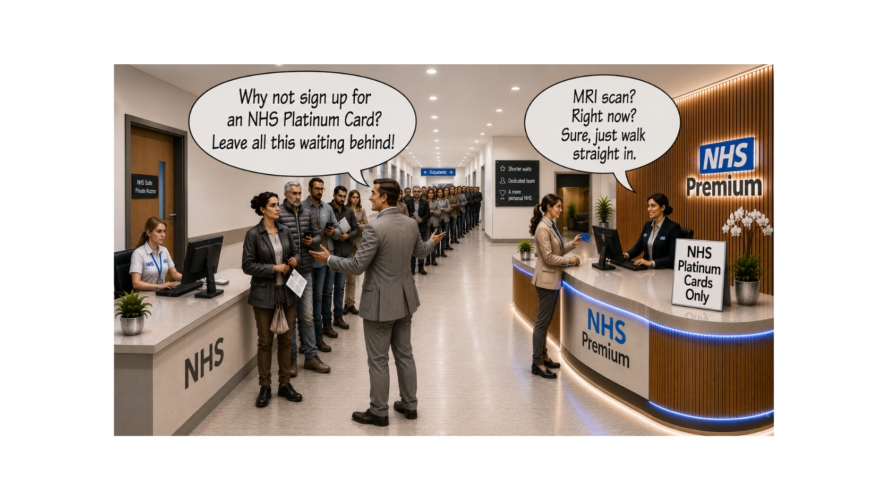
Forced to go private? Not for better treatment, but just to know you can get an answer
A poll of 2,593 adults, published in March 2026 by Healthwatch’s Savanta , found that private healthcare use had nearly doubled from 9% to 16%, with long waits now the leading reason
Thirty-nine per cent named waiting as their main motivation, compared with 31% citing better quality. Private healthcare’s decisive attraction may increasingly be earlier treatment, rather than clinically superior treatment
From a ReplyResearch perspective, patients may be paying to escape an unreachable, uncontactable and unresponsive pathway, and to reach somebody who answers, confirms what is happening and provides a date
The premium isn’t better treatment. It’s being able to reach someone
This is why ReplyResearch is examining healthcare. Responsiveness is not decorative customer service surrounding the clinical system; it helps determine whether patients can actually enter, understand and safely navigate that system
A service can remain nominally available while becoming operationally unreachable. The entitlement exists, but the patient cannot establish a practical route from worsening symptoms to assessment, decision and treatment
An organisation can publish telephone numbers, inboxes and portals while remaining uncontactable. Contactability requires reaching somebody able to investigate the problem, accept ownership and explain what happens next
It can also reply without becoming responsive. An acknowledgement, generic holding message or unexplained status update is not a useful response when the patient needs confirmation, action, judgement or escalation
The evidence is catching up with the joke
Healthwatch’s March 2026 study found confidence especially weak for timely non-urgent operations and diagnostic tests, at 22% and 28% respectively. The perceived premium is access before deterioration
The King’s Fund reported in June 2026 that 46% of surveyed patients rated their waiting experience poor, while 44% were dissatisfied with communication despite improving headline performance
The ONS Health Insight Survey, published in September 2025, found 64.6% of people reporting a poor wait wanted more regular updates, while 50.9% wanted confirmation of their waiting-list place
Private healthcare does not merely sell earlier treatment. It can sell reachable treatment: an answered telephone, a confirmed appointment, a named contact and an intelligible next step
Every extra week has a price
Calling delay a service inconvenience may make sense for restaurant bookings or parcel deliveries. In healthcare, delay can alter symptoms, treatment options, recovery prospects and sometimes the likelihood of survival
A January 2026 BMJ analysis of cancer services stated that treatment delays are associated with increased risk of death. Timeliness is therefore not surrounding quality; it can be clinical quality
The underlying 2020 BMJ systematic review examined seven major cancers and found mortality increased with each four-week treatment delay across surgery, systemic treatment and radiotherapy, although risks varied
Outside cancer, the Nuffield Trust’s April 2026 waiting-time review warned that prolonged delays can bring worse prognosis, more complex surgery, heavier medication and slower recovery. Earlier care changes later care
Universal healthcare shouldn’t require detective work
England’s constitutional standard says 92% of patients should begin consultant-led treatment within eighteen weeks. That promise matters because it defines timely care as an entitlement, rather than an optional enhancement
NHS England’s July 2026 release showed 7.3 million pathways awaiting treatment in May, representing about 6.2 million people. Only 65.6% were within eighteen weeks, missing the 92% standard
The position had improved. The list was 1.1% smaller than a year earlier, while the proportion within eighteen weeks rose by 4.6 percentage points. An honest assessment should acknowledge progress
Yet an interim target near 65% can be achieved while more than one-third of pathways exceed eighteen weeks. Administrative success and operational unreachability can therefore occupy the same spreadsheet
Patients are disappearing before they even join the queue
Waiting-list headlines count pathways, not simply people, and some patients have several pathways. They also begin only after referral, excluding people still struggling to obtain diagnosis or specialist access
A 2025 Nuffield Trust analysis cautioned that a falling planned-care list does not necessarily mean more health need is being met, because referrals, removals and treatment activity can move independently
The King’s Fund warned in September 2025 that the unexpectedly smaller post-pandemic list might conceal substantial clinical risk, including people who never returned, never reached referral or deteriorated elsewhere
A patient who pays privately and leaves an NHS pathway has received care, but that departure does not demonstrate restored NHS capacity. A shrinking queue and widening private escape route can coexist
The waiting list isn’t the beginning
For the patient, the uncertainty may begin before any official clock starts. They may not know whether the referral arrived, was accepted, was triaged correctly or remains clinically appropriate
Nominal availability becomes operational unreachability when entry, ownership or status cannot be established. The patient is theoretically inside a universal service while practically unable to reach the decision-making pathway
A telephone number or portal is not contactability when neither reaches anyone who can investigate. An inbox is not access when messages vanish without ownership, explanation or meaningful reply
Each failure transfers monitoring back to the patient. Somebody already unwell must detect deterioration, interpret silence, identify the correct department and somehow persuade the system that circumstances have changed
Delay sends the invoice somewhere else
A 2024 BMC Health Services Research study compared 44,616 people waiting beyond eighteen weeks with matched controls. Those waiting used more primary care, prescriptions and secondary care, depending on specialty
The researchers described this additional activity as failure-demand: work generated because an earlier need remained unresolved. Orthopaedic patients recorded extra primary-care contacts, prescriptions and secondary-care contacts while waiting
An October 2025 NHS England and ONS analysis linked hospital and tax records for roughly thirty million working-age people. Restoring the standard could generate at least £2.7 billion additional pay by 2030–31
Delay therefore appears cheap only when consequences sit elsewhere. The appointment budget saves today, while patients, employers, general practice, emergency services and future treatment absorb tomorrow’s financial and clinical cost
Silence has become part of the treatment pathway
Elapsed time is only one part of waiting. Patients also endure uncertainty about whether referrals arrived, where they stand, when anything will happen and whom they can contact when circumstances worsen
That uncertainty makes unresponsiveness more than discourtesy. It can prevent patients distinguishing an expected delay from administrative failure, unsafe deterioration or the possibility that they have quietly left the pathway
The King’s Fund and ONS findings suggest patients are not demanding impossible certainty. They are asking for confirmation, realistic information, regular updates and a route to somebody capable of responding
Communication cannot manufacture theatres, clinicians or scanners. It can, however, reveal changing clinical need, prevent silent disappearance, support informed decisions and stop every unanswered question becoming another avoidable contact
Perhaps the product isn’t healthcare. It’s certainty
Private treatment is often discussed as though patients are purchasing different medicine. The evidence suggests many are purchasing elapsed time, navigational certainty and the ability to make somebody take responsibility sooner
PHIN’s March 2026 market update recorded 230,340 private admissions during the third quarter of 2025. Insured admissions reached their highest third-quarter level, while self-pay remained substantial but unchanged year-on-year
Funding divided roughly seventy-thirty between insurance and self-pay. The premium route is therefore not confined to wealthy cash buyers; it is increasingly mediated through employment benefits and commercial insurance
The proposition can sound modest: not better surgery, merely an earlier consultation, scan or diagnosis. When earlier action changes pain, prognosis or treatment complexity, responsiveness becomes part of the treatment
The premium may simply be an answer
The commercial promise is not that every private provider answers perfectly. It is that payment opens a more direct organisational route towards booking, confirmation, responsibility and a date that can be understood
NHS care may remain free at the point of use while demanding extensive unpaid navigation from the patient. Time spent chasing, repeating, checking and escalating becomes another unequally distributed healthcare cost
The distinction is therefore not merely a faster clinical slot. A reachable organisation reduces uncertainty by connecting the patient to somebody who can locate the case, explain its status and act
When the NHS cannot say when treatment will occur, and cannot provide anybody who can meaningfully answer, does private healthcare begin selling responsiveness as a clinical necessity?
One healthcare system. Two speeds
NHS-funded treatment inside a private hospital is not a premium service charged to the patient. It remains taxpayer-funded care, and using available independent capacity can shorten some waits
Patients in England already have rights to choose among eligible providers, including independent organisations. NHS England’s January 2025 partnership agreement says quality standards should apply regardless of provider ownership
However, the same independent sector serves NHS-funded, insured and self-paying patients. Those routes differ financially, yet can draw upon overlapping hospitals, clinicians, diagnostic capacity and administrative systems
The troubling divide is therefore not simply NHS building versus private building. It is one clinical economy containing different routes to time, with purchasing power influencing which route opens fastest
The partnership is no longer hypothetical
The January 2025 agreement between NHS England and the Independent Healthcare Providers Network said their partnership was stronger and committed both sides to deeper planning, collaboration and shared recovery work
It reported that independent providers treated more than one million NHS patients during 2024. Commissioners were encouraged to pursue long-term contractual relationships and support further private investment in elective capacity
The government said the sector could provide another million NHS appointments annually and called independent providers a critical part of the NHS’s long-term recovery and renewal. This is established policy
That partnership can be defended as pragmatism during a capacity crisis. It also embeds organisations serving patients who pay for escape from the same delays those organisations are publicly contracted to reduce
Nobody needs to cheat for this to happen
NHS commissioners purchase independent capacity because public waits are too long. Meanwhile, the experience of delay encourages insured and self-paying patients to purchase access from the independent sector directly
No single transaction proves wrongdoing. Nevertheless, the sector can earn public revenue for helping clear the backlog and commercial revenue from people who believe they cannot tolerably remain within it
This creates a structural tension. Waiting is simultaneously the public problem private providers are contracted to solve and the market condition increasing demand for their separately priced services
The question is not whether providers secretly manufacture delay. It is whether a system becomes comfortable with delay when organisations embedded within recovery also possess a commercial route around it
The incentives may already be enough
The public evidence reviewed for this article does not establish that NHS leaders and private providers conspired to delay treatment so patients would pay. Claiming that would outrun the evidence
The official agreement says independent provision should deliver high-quality care, transparency and value for taxpayers, while NHS-commissioned treatment remains free. Those intentions and safeguards deserve accurate representation
The concern is more systemic. Institutions can pursue defensible local objectives while collectively producing dependency, unequal access and profit from scarcity, without anybody openly designing that overall result
That is why collusion may be the wrong investigative frame. The stronger question asks whether policy incentives can normalise a premium market in timely, reachable care while every participant claims efficiency
Outsourcing is easy. Rebuilding isn’t
Independent hospitals can supply real theatres, beds, scanners and appointments. For a patient treated months sooner, arguments about ownership may reasonably feel less important than relief, mobility or earlier diagnosis
Yet the Health Foundation noted in 2024 that privately funded healthcare faces structural limits, including restricted independent capacity and the substantial share already occupied delivering NHS-funded care. Capacity is finite
The BMA’s 2024 report said 83% of surveyed doctors feared outsourcing would worsen NHS staff availability, while 80% expected the NHS to provide more aftercare. This was professional polling
If both sectors rely substantially upon the same trained workforce, buying external activity may redistribute scarce labour rather than create it. The immediate queue falls while public capability remains unchanged
Routine patients keep difficult medicine alive
Independent providers commonly concentrate on planned, high-volume procedures, while NHS hospitals retain emergency departments, intensive care, training and patients with multiple conditions. Procedure prices can therefore compare unlike obligations
The Health Foundation’s analysis of ophthalmology and orthopaedics found independent provision expanded most in selected inpatient specialties. Private hospitals are not simultaneously carrying the same urgent and emergency pressures
The BMA described the danger as cherry-picking routine, lower-complexity work, leaving the NHS with costlier cases and fewer training opportunities. That warning does not prove every contract behaves identically
Routine activity is not trivial. It can supply income, predictable theatre experience and training volume that help sustain complex services absent from the outsourced procedure’s apparently efficient unit price
One operation exposes the whole model
A July 2024 CHPI study used information from fifty NHS trusts and a survey of 198 ophthalmologists. It found NHS hospitals were performing about 20% fewer cataract operations than five years earlier
Sixty-two per cent of surveyed ophthalmologists reported a negative effect on training opportunities, while half the sampled trusts experienced a 21% income decline. CHPI argues routine cataracts support complex eye care
CHPI’s April 2025 follow-up estimated five companies received £536 million from NHS cataract services during 2023–24 and generated £169 million EBITDA, claiming one pound in every three became profit
The organisation also reported financial interests linking some NHS consultants with private clinics, while explicitly saying further research was needed to establish effects upon care. That caveat matters
Efficiency for the spreadsheet. Costs for everyone else
The Public Accounts Committee reported in November 2025 that NHS England spent £3.24 billion transforming diagnostic and surgical services yet missed recovery goals by significant margins. Extra capacity underperformed expectations
The committee criticised programmes receiving billions without sufficient focus on outcomes for patients. Activity, buildings and unit costs may improve while the outcome that matters, timely effective care, remains inadequate
A contract can appear efficient when calculation excludes training loss, complex aftercare, emergency backup, profit extraction, duplicated administration and the additional healthcare use generated while other patients continue waiting
Real efficiency must examine the whole pathway over several years. Otherwise, costs are not removed; they are transferred into another budget, another institution or the patient’s life
Pain isn’t a free market
Official reform language emphasises patient choice and empowerment. Choice can be valuable when an NHS patient selects a faster eligible provider without paying, especially where local capacity differs sharply
But spending savings because pain, fear or deterioration makes waiting intolerable is not ordinary consumer preference. It is a constrained response to an essential service arriving too late
Healthwatch’s March 2026 poll exposed the income gradient: 10% of people earning below £20,000 used private care, compared with 35% earning at least £80,000. Time follows purchasing power
The Health Foundation’s July 2026 analysis also found deprivation-related waiting inequalities persisted despite recent improvement. Even before self-payment, equal entitlement does not produce equal chronological access
Healthcare is becoming another employment benefit
The Independent Healthcare Providers Network’s 2025 industry-backed survey found 71% would consider private care, while 46% of previous users cited difficulty accessing NHS appointments. Commercial provenance requires caution
The same research found 62% believed every workplace should offer private healthcare, while younger respondents increasingly valued insurance within employment. Timely treatment is becoming part of remuneration
That development makes healthcare speed partly dependent upon labour-market position. Secure professionals may receive insured access through work, while others must self-fund, borrow, depend upon family or wait
A 2024 Survation poll commissioned by 38 Degrees found 22% of private users incurred debt, including loans or family borrowing. Campaign sponsorship matters, but the finding challenges effortless choice
The trend matters more than the headline
The latest PHIN figures do not show an uncontrolled self-pay explosion. Self-funded admissions were unchanged between the third quarters of 2024 and 2025, while insurance drove record activity
The Health Foundation similarly concluded in 2024 that there had not been a major population-wide surge into private healthcare. Limited capacity, affordability and NHS-funded use constrain market expansion
The overwhelming majority of healthcare remains publicly funded, and independent provision can reduce particular waits. Britain has not completed a wholesale replacement of the NHS with private medicine
The concern is trajectory and normalisation. A two-tier system need not replace the NHS; it only needs timely, reachable access to become predictably better for people with money, insurance or influence
If this is the future, let’s make it honest
Reassurance requires more than promises of choice. Commissioners should publish comparable data on waits, outcomes, case complexity, workforce sources, transfers, aftercare, training activity, profits and patient experience
They should demonstrate that contracted capacity is genuinely additional, rather than produced by drawing clinicians from NHS work. Otherwise, purchased activity can disguise a transfer of time between queues
Patients also need confirmation, regular updates, realistic dates and an accessible escalation route before desperation pushes them towards payment. Communication cannot cure insufficient capacity, but silence magnifies inequality
Most importantly, success should be measured through outcomes and timely completed pathways, not appointments purchased or procedures counted. A cheaper unit is not efficient when the surrounding system weakens
Responsiveness is treatment
Hospitals should examine contactability as seriously as waiting time: whether patients can confirm a referral, reach the responsible team, report deterioration and obtain a useful response without repeated pursuit
A service should not count itself accessible merely because channels exist. The meaningful measure is whether those channels connect patients to understanding, ownership, decision and appropriate clinical action
Opaque waiting transfers administrative and clinical vigilance towards sick people. The patient becomes the tracking system, escalation mechanism and safety net for a pathway they cannot properly see
Responsiveness will not shorten every queue. It can stop the queue becoming a black hole in which uncertainty, changing symptoms and administrative failure remain unreachable until harm becomes visible
When time has a price, healthcare has two tiers
Ipsos polling for the Health Foundation in May 2025 found continuing overwhelming support for care free at the point of delivery. That principle remains politically and emotionally central to the NHS
Yet universality cannot concern price alone. Healthcare is meaningfully universal only when people can obtain clinically appropriate care within a reasonable period, without money determining whether crucial months disappear
A service may remain formally free while becoming chronologically tiered. Everyone retains the same theoretical treatment, but some receive it before prolonged pain, lost work, deterioration or reduced options accumulate
The slogan remains fictional. The danger is that patients increasingly recognise its logic: NHS care is free, but when time really matters, reachable medicine may already be the premium option

Sources for We’re proud to offer free NHS healthcare. But if time really matters, why not try our premium option?
Research mentioned in the article
- Healthwatch, “Two-tier healthcare increases as confidence in timely access remains low” – 16 March 2026.
Read the Healthwatch report
This reports the Savanta poll of 2,593 adults used in the article. It supports the figures on increasing private healthcare use, waiting times as the leading motivation, low confidence in timely NHS treatment and the pronounced income gradient in private use. - The King’s Fund, “Waiting matters: bringing down NHS waiting lists is important but so is the experience of waiting” – 9 June 2026.
Read the King’s Fund analysis
This analysis examines the experience of patients waiting for NHS care. It supports the article’s discussion of poor waiting experiences, dissatisfaction with communication and the distinction between improving headline waiting-list performance and improving the experience of individual patients. - Office for National Statistics, “Experiences of NHS healthcare services in England: September 2025” – 11 September 2025.
Read the ONS statistical bulletin
The Health Insight Survey found that, among people reporting a poor waiting experience, 64.6% believed more regular updates would improve it and 50.9% wanted confirmation of their place on the waiting list. - BMJ, “Early cancer diagnosis is vital, but treatment delays are causing harm to patients” – 14 February 2025.
Read the BMJ analysis
This is the closest identifiable BMJ analysis to the article’s reference to a “January 2026 BMJ analysis of cancer services”. It argues that treatment delays are harming cancer patients, but its February 2025 publication date does not match the date given in the article. - Hanna and others, “Mortality due to cancer treatment delay: systematic review and meta-analysis” – 4 November 2020.
Read the BMJ systematic review
This is the systematic review explicitly discussed in the article. It examined seven major cancers and found that four-week increases in delays to surgery, systemic treatment or radiotherapy were associated with increased mortality risk, although the size of the association varied. - Nuffield Trust, “Elective treatment waiting times” – updated 30 April 2026.
Read the Nuffield Trust review
This review supplies the article’s wider context on prolonged elective waits, the constitutional expectation that 92% of patients should begin consultant-led treatment within eighteen weeks, and the continued failure to meet that standard. - NHS England, “Consultant-led Referral to Treatment Waiting Times Data 2026–27” – July 2026 release covering May 2026.
Open the NHS England RTT data
This is the official dataset behind the article’s figures for the number of incomplete treatment pathways, the approximate number of individual patients waiting and the percentage of pathways completed within eighteen weeks. - Nuffield Trust, “Why is the planned care waiting list coming down and what does the data really tell us?” – August 2025.
Read the Nuffield Trust analysis
This supports the article’s warning that a falling waiting list does not necessarily mean more health need is being met. It examines referrals, completed pathways, validation and large numbers of incomplete pathways removed without being reported as completed. - The King’s Fund, “The missing millions from the NHS waiting list” – 11 September 2025.
Read the King’s Fund article
This explores why the post-pandemic waiting list did not grow as dramatically as anticipated and warns that substantial unmet need and clinical risk may remain among people who never returned, never secured referral or remained outside the recorded list. - James, Denholm and Wood, “The cost of keeping patients waiting: retrospective treatment-control study of additional healthcare utilisation for UK patients awaiting elective treatment” – 30 April 2024.
Read the BMC Health Services Research study
The study compared 44,616 patients waiting beyond eighteen weeks with matched controls. It found greater use of primary care, prescriptions and secondary care among waiting patients and described the additional activity as a potential false economy and form of failure demand. - Government Analysis Function, “Exploring how personal health affects economic activity” – 30 October 2025; related ONS and NHS England preprint revised December 2025.
Read the government case study
Read the linked-data preprint
The government case study explains the linking of hospital and tax records to examine the relationship between waiting times, health and employment. The subsequent preprint contains the estimate that restoring the eighteen-week standard could produce at least £2.7 billion in additional pay by 2030–31. The estimate itself therefore post-dates the October case study. - Private Healthcare Information Network, “March 2026 private healthcare market update” – March 2026.
Read the PHIN market update
This is the source for the article’s figures on 230,340 private admissions during the third quarter of 2025, record third-quarter insured admissions, stable self-pay activity and the approximate seventy-thirty split between insured and self-funded admissions. - NHS England and the Independent Healthcare Providers Network, “Elective recovery: a partnership agreement between the NHS and the independent sector” – 6 January 2025.
Read the partnership agreement
Read the accompanying government announcement
The agreement supports the article’s account of deeper planning, commissioning and collaboration between NHS England and independent providers. It states that the independent sector treated more than one million NHS patients during 2024 and addresses additional capacity, patient choice, workforce effects and data transparency. - Health Foundation analysis reported by the Financial Times, “Privately funded hip replacements surge as patients shun NHS backlogs” – 31 August 2024.
Read the Financial Times report
This reports Health Foundation analysis showing a marked increase in privately funded hip replacements but only a modest overall increase in privately funded elective inpatient care. It supports the article’s caution against claiming a wholesale population-wide shift into private healthcare. A subscription may be required. - British Medical Association, “NHS outsourcing” – survey conducted February 2022.
Read the BMA analysis
The BMA reports that 83% of surveyed doctors were concerned about NHS staff availability, while 81% raised concerns about NHS funding and sustainability and 81% about training. The BMA page says the survey was conducted in February 2022, not 2024, and it does not display the article’s separate 80% aftercare figure. - Health Foundation, “Waiting for NHS hospital care: the role of the independent sector” – 30 April 2023.
Read the Health Foundation analysis
This examines the growth of independent provision in selected planned-care specialties, particularly ophthalmology and trauma and orthopaedics, and the different operational roles carried by independent and NHS hospitals. The identifiable publication is from 2023, although the article describes it as a 2024 analysis. - Centre for Health and the Public Interest, “Out of Sight: the hidden impact of cataract outsourcing on NHS eye care departments” – 10 July 2024.
Read the CHPI report
Based on information from fifty NHS trusts and a survey of 198 ophthalmologists, this is the source for the article’s figures on falling NHS cataract activity, reduced trust income and reported damage to ophthalmology training opportunities. - Centre for Health and the Public Interest, “Out of Sight: the hidden profits and conflicts of interest behind the outsourcing of NHS cataract care” – April 2025.
Read the CHPI follow-up report
This follow-up supplies the article’s estimates for NHS cataract payments to five companies, their reported EBITDA and possible financial interests connecting some NHS consultants with private clinics. The report itself states that further research is needed to establish effects on care. - House of Commons Public Accounts Committee, “Reducing NHS waiting times for elective care” – 19 November 2025.
Read the Public Accounts Committee summary and report
This is the source for the article’s statement that NHS England spent £3.24 billion on diagnostic and surgical transformation but missed recovery targets. The committee criticised insufficient focus on patient outcomes and uncertainty about what the spending actually delivered. - Health Foundation analysis reported by The Independent, “NHS patients in most deprived areas face significantly longer waits” – 17 July 2026.
Read The Independent’s report
This reports Health Foundation analysis finding that deprivation-related inequalities in treatment waiting times persisted despite national improvement. It supports the article’s argument that formally equal entitlement does not necessarily produce equal access in time. - Independent Healthcare Providers Network, “Going Private 2025: headline findings” – August 2025.
Read the IHPN survey findings
The industry-backed survey is the source for the article’s findings that 71% would consider private healthcare, 46% of previous users cited difficulty accessing NHS appointments and 62% believed workplaces should offer private healthcare. Its commercial provenance should remain clear. - 38 Degrees and Survation, “‘Wait or pay’: fears NHS waiting lists are creating a two-tier system” – 6 May 2024.
Read the 38 Degrees report of the Survation poll
This is the source for the article’s claim that 22% of people who had used private healthcare incurred debt, including borrowing through loans, credit cards, family or friends. The commissioning organisation’s campaign role should be acknowledged. - Ipsos and the Health Foundation, “Easier access to GP appointments remains public’s top priority for the NHS” – 12 September 2025; fieldwork conducted 8–14 May 2025.
Read the Ipsos findings
This is the polling referenced near the article’s conclusion. It found continued overwhelming public support for an NHS providing care free at the point of delivery, while also identifying access and waiting times as major public priorities.
Important source-matching caution: four references need checking before publication because the article’s wording does not align precisely with the identifiable source: the “January 2026” BMJ analysis, the BMA’s purported “2024 report” and 80% aftercare statistic, the Health Foundation analysis described as 2024 but published in 2023, and the October 2025 attribution of the £2.7 billion estimate, which appears in a later preprint.

Footnote Zone for : “We’re Proud To Offer Free NHS Healthcare. But If Time Really Matters, Why Not Try Our Premium Option?”
Disclosure: The diagnostic tools referenced below were developed by NokNok, a specialist in online responsiveness tool design.
This Footnote Zone uses NokNok’s diagnostic toolkit to examine how the responsiveness failures and communication breakdowns described in this article can be identified, measured, and addressed.
- Email Finder: Pair this tool with the trend of healthcare providers and administrative pathways hiding contact options, abandoning mailboxes, obscuring email access, or creating web-form friction. Email Finder scans an organization’s website and related public-facing materials for published email addresses, then reports on structural deficiencies, discrepancies, missing contact routes, or other contactability gaps.
- Reply Radar: Pair this tool with the trend of plummeting response times, ignored messages, delayed patient replies, understaffed human queues, and unreliable customer-response operations across the healthcare system. Reply Radar deploys targeted test emails and quantitatively measures reply rates, latency, response consistency, and related responsiveness benchmarks.
- Compliance Sniffer: Pair this tool with the issue of automated “hallucination loops,” empty platitudes, degraded message quality, evasive responses, or failure to meet basic communication and compliance expectations when patients attempt to track their referral or waiting-list status. Compliance Sniffer analyzes incoming responses for objective quality, clarity, relevance, escalation, and compliance benchmarks.
- Mystery Shopper: Pair this tool with systemic user-experience breakdowns, aggressive gateway filters, obstructive online forms, defensive user journeys, broken escalation paths, and end-to-end contact failures that force patients to perform detective work just to find their place in the queue. Mystery Shopper executes a comprehensive end-to-end responsiveness UX audit, testing how a real user experiences the organization’s contact, response, and escalation pathways.
Disclosure: The diagnostic tools referenced in this Footnote Zone were developed by NokNok, a specialist in online responsiveness tool design. ReplyResearch may use NokNok tools, resources, or analysis when preparing coverage, while retaining responsibility for its editorial decisions, including what topics to cover, what sources to cite, and how stories are presented. Read the full ReplyResearch Collaborative Disclosure Policy.